
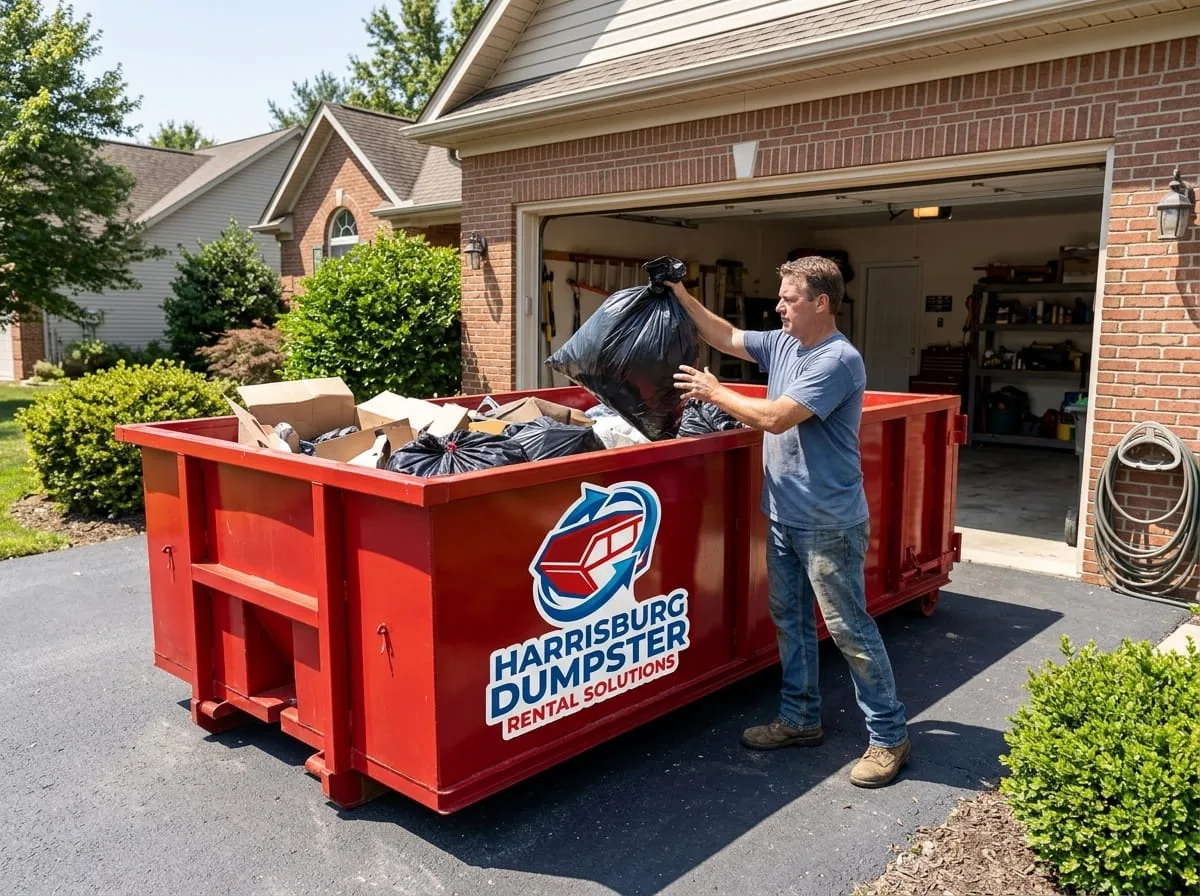
Ice storms, spring floods, summer thunderstorms. When Central PA weather turns, every dumpster in the county is spoken for within 48 hours. Here is how to be ahead of that.
Central Pennsylvania has a weather problem
We sit in a valley, on a major river, at a latitude where winter cannot decide whether it wants to snow or rain. The results are predictable and they arrive every year.
Ice storms bring down mature limbs across Lower Paxton and Susquehanna Township. Spring brings high water on the Susquehanna and Swatara Creek, and with it wet basements across the low-lying neighbourhoods. Summer thunderstorms take down trees and strip shingles. Occasionally, the remnants of a tropical system come up the coast and remind everyone what the river is capable of.
None of this is new information to anyone who has lived here. What surprises people is how fast the cleanup infrastructure gets saturated afterwards.
The 48-hour scramble
When a significant weather event hits Dauphin County, the phones at every hauler in the region light up within a day. Containers that were freely available on Monday are booked out for a week by Wednesday afternoon.
This is simple arithmetic. There is a finite number of roll-off containers in the Capital Region and a sudden, simultaneous, area-wide demand for all of them.
The practical implication: if a storm has damaged your property, call early. Not because we want to rush you, but because the container you can get on Tuesday may not exist on Friday. We hold back capacity for storm response precisely because we know this happens, but that capacity is finite too.
Safety before cleanup — every time
This section is not padding. People are seriously hurt every year doing storm cleanup, and the injuries follow a depressingly predictable pattern.
- Downed power lines. Assume every line is live. Assume it regardless of what it looks like. Call the utility and stay well clear, including of anything touching the line — fences, trees, standing water.
- Chainsaws and tension. A downed limb under tension will move violently when cut. If you are not confident about where the tension is, hire an arborist. This is how people lose fingers and worse.
- Ladders on soft ground. After heavy rain, ground that looks firm is not. Ladder falls during storm cleanup are common and consequential.
- Flood water. Treat any standing water in a basement as contaminated. It is not just river water; it may have picked up sewage, fuel and chemicals along the way. Boots, gloves, and do not touch your face.
- Structural damage. If a tree has hit the house, get someone qualified to look at the structure before you start hauling debris out from under it.
The container will still be there tomorrow. Your hands and your spine are harder to replace.
Flood debris is heavier than you think
This is the single most common sizing mistake in flood cleanup, and it costs people money every spring.
Water-saturated carpet, underlay, drywall, insulation and furniture weigh an extraordinary amount. Dry drywall is heavy enough at roughly 500 pounds a cubic yard. Wet drywall is far worse. A sodden sofa can weigh three or four times what it did dry.
For a flooded basement clear-out, book a 15 or a 20 yard container — not a 30. It will look half empty and it will be at its weight limit. That is normal, that is correct, and any hauler who tells you to put wet basement debris in a 30 yard box is setting you up for an overage charge.
Document everything before you throw it away
If you are making an insurance claim — and after a serious storm you probably are — the debris in your basement is evidence.
Photograph everything before it goes in the container. Wide shots showing the extent of the damage. Close shots of individual items. Serial numbers and model plates on appliances. The water line on the wall. The date stamps matter.
Speak to your adjuster before you dispose of large or valuable items if you possibly can. A container that arrives before the adjuster does can create a genuine problem with a claim, and "I threw it away" is a difficult position to argue from.
This is the one situation where speed is not the priority. Get the documentation right, then clear up.
Brush and green waste: the one time to go big
Storm debris is mostly limbs, branches and brush, and this material is the exception to almost every sizing rule we give.
Brush is bulky and comparatively light. It packs badly, it springs back, and it takes up far more volume than its weight suggests. This is one of the very few residential situations where a 30 yard container is genuinely the economical choice — you are buying volume, and the weight will never come close to the limit.
Cut limbs down to manageable lengths before loading and stack rather than throw. You will fit perhaps twice as much in the same container, which on a large tree removal is the difference between one haul and two.
Separate what you can
- Clean brush and timber — sometimes processed more cheaply than mixed debris. Worth asking about on a large job.
- Metal — damaged gutters, downspouts, fencing, roofing. Set it aside; it has scrap value and it keeps weight out of your container.
- Electronics and appliances damaged by flood water still need to go to the county recycling centre, not into the container. Water damage does not change that.
- Hazardous materials — fuel cans, chemicals, paint that got wet in a flooded garage. Still hazardous. Still a separate stream.
What we do differently in storm season
We keep capacity in reserve. When a bad weather event hits the county, we do not simply take bookings in the order they arrive and let everyone else wait — we prioritise properties with genuine damage: open roofs, flooded living space, trees on structures.
We will tell you honestly when we can get to you. If it is three days, we will say three days rather than promising tomorrow and not turning up. In a week when your basement is full of water, the last thing you need is a hauler who over-promises.
If a storm has hit your property, call us. Tell us what you are dealing with, tell us how bad it is, and we will give you a straight answer about when a container can be there and what size you actually need.