
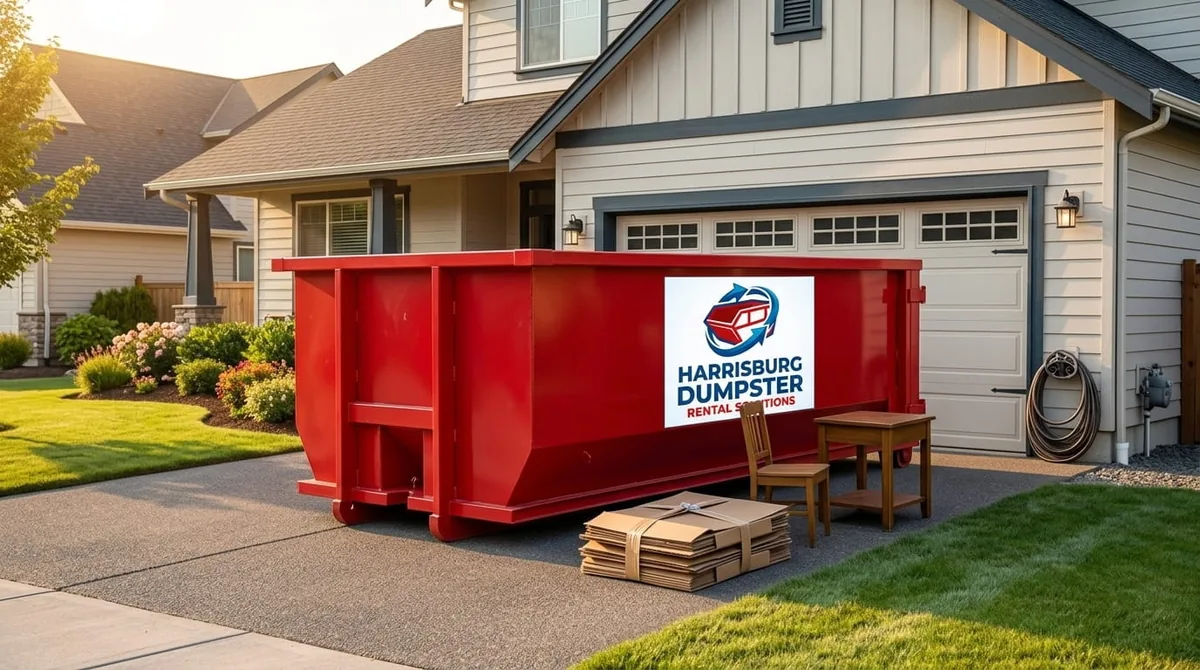
Midtown, Allison Hill, Shipoke, Uptown. Beautiful old housing stock, no driveways, narrow streets and a hundred years of plaster to get rid of. Here is how to do it properly.
The rowhome problem in one sentence
A Harrisburg rowhome renovation produces an enormous volume of very heavy debris, and there is nowhere obvious to put the container.
That is the whole challenge. Everything else — the permit, the swap schedule, the neighbour management, the sizing — is downstream of those two facts.
Get the waste plan right before you swing the first sledgehammer and the job runs smoothly. Get it wrong and you will spend the first week of your renovation stacking plaster in the back yard while you sort out a permit you should have applied for a fortnight ago.
Step one: work out where the container is going
There are, realistically, three options, and you need to establish which one applies before you do anything else.
- The street. The most common answer. It requires a City of Harrisburg permit for occupancy of the right-of-way, and it takes a parking bay or two out of commission for the duration.
- The rear alley. Sometimes possible, often not. Alleys behind Harrisburg rowhomes are narrow, frequently obstructed, and not always able to accommodate a roll-off truck's turning and lifting requirements. Do not assume — have your hauler look at it.
- A neighbour's driveway. Occasionally the answer, if you have an accommodating neighbour with a corner property and a driveway that can take it. Worth asking. Worth being generous about.
If it is the street — and it usually is — start the permit process immediately. This is the single most common cause of delay on rowhome projects, and it is entirely avoidable.
Step two: understand what plaster weighs
Harrisburg's rowhomes predate drywall. What is on the walls is plaster over wood lath, and it is far heavier than the gypsum board that replaced it.
This is the number one thing that catches first-time rowhome renovators. You look at a 20 yard container that appears to be half full and assume you have plenty of room left. You do not. The weight allowance is already gone.
Practical rule: for a rowhome interior strip, book a 20 yard container and plan on more than one. A full gut of a three-storey rowhome — plaster, lath, flooring, old cabinetry, framing, trim, the accumulated contents of a century — will not fit in a single container. It rarely fits in two.
Step three: plan the swaps around your crew
Demolition is fast and it is front-loaded. A crew of three can strip a floor to the studs in a day, and when the container is full at 11am on day two, everything stops.
Talk to your hauler about the demolition schedule before it starts. If we know you are gutting three floors over five days, we can build the swaps into the schedule and have a truck arriving before your crew runs out of room, not two hours after.
Ad-hoc swap requests at 2pm on a Friday are the ones that do not happen. Scheduled swaps are the ones that do.
Step four: manage the street and the neighbours
A container in a Midtown parking bay for two weeks is a real imposition on people who already struggle to park. This is worth taking seriously, and not only because you have to live next to these people afterwards.
A neighbour who is annoyed enough will call code enforcement. A neighbour who has been kept informed will not.
- Talk to the immediate neighbours before the container arrives. Tell them how long it will be there.
- Keep the area around the base of the container swept and clear of spilled debris.
- Make sure the container is properly marked and visible at night.
- Do not let anyone else fill your container — an unattended dumpster on a public street is an invitation, and you pay for the weight.
- Take it away as soon as the job allows. Do not leave an empty container sitting in a parking bay because it is convenient for you.
Step five: the things that must not go in
Old Harrisburg housing stock brings specific hazards, and they are not optional to think about.
Lead paint. Anything painted before 1978 is a candidate. Disturbing it during demolition creates dust that is a genuine health risk, particularly to children, and the waste stream may need special handling.
Asbestos. Common in old flooring, pipe lagging, and some plaster and ceiling products. It is not a maybe in buildings of this age — it is a question worth answering with a test before demolition starts, not after.
Neither of these belongs in a roll-off container without proper assessment. If you find something you are unsure about, stop and get a licensed abatement contractor to look at it. It is a delay. It is a much smaller delay than the alternative.
A realistic waste plan for a full gut
Here is roughly how a three-storey rowhome interior strip actually goes, from a waste perspective.
- Two weeks out: apply for the street occupancy permit. Confirm access and container placement with the hauler.
- One week out: pre-demolition assessment for asbestos and lead. Book the container and schedule the first swap provisionally.
- Day 1: 20 yard container delivered to the permitted street bay. Demolition starts at the top floor and works down.
- Day 2–3: container fills with plaster and lath. Swap scheduled for the morning of day 3.
- Day 3–5: second container takes flooring, cabinetry, framing, trim and general debris.
- Day 5–6: final swap or pickup. Street bay released. Sweep up.
- Throughout: metal set aside for scrap. Anything salvageable — doors, trim, hardware, mantels — set aside for reuse. Old rowhome trim in particular is worth saving.
The salvage worth saving
One last thing, and it is not really about dumpsters at all.
Harrisburg rowhomes contain materials that simply are not made any more — old-growth heart pine flooring, solid doors, hand-turned newel posts, mantelpieces, hardware. Architectural salvage buyers and reuse organisations will take these, sometimes pay for them, and they will absolutely find a better home than a combustion facility.
Set them aside before demolition day, not during. Once the sledgehammers are swinging, everything looks like debris.
If you are planning a rowhome renovation and want to talk through the waste side of it before you start — placement, permits, sizing, swaps — call us. We do these constantly and the conversation costs you nothing.