
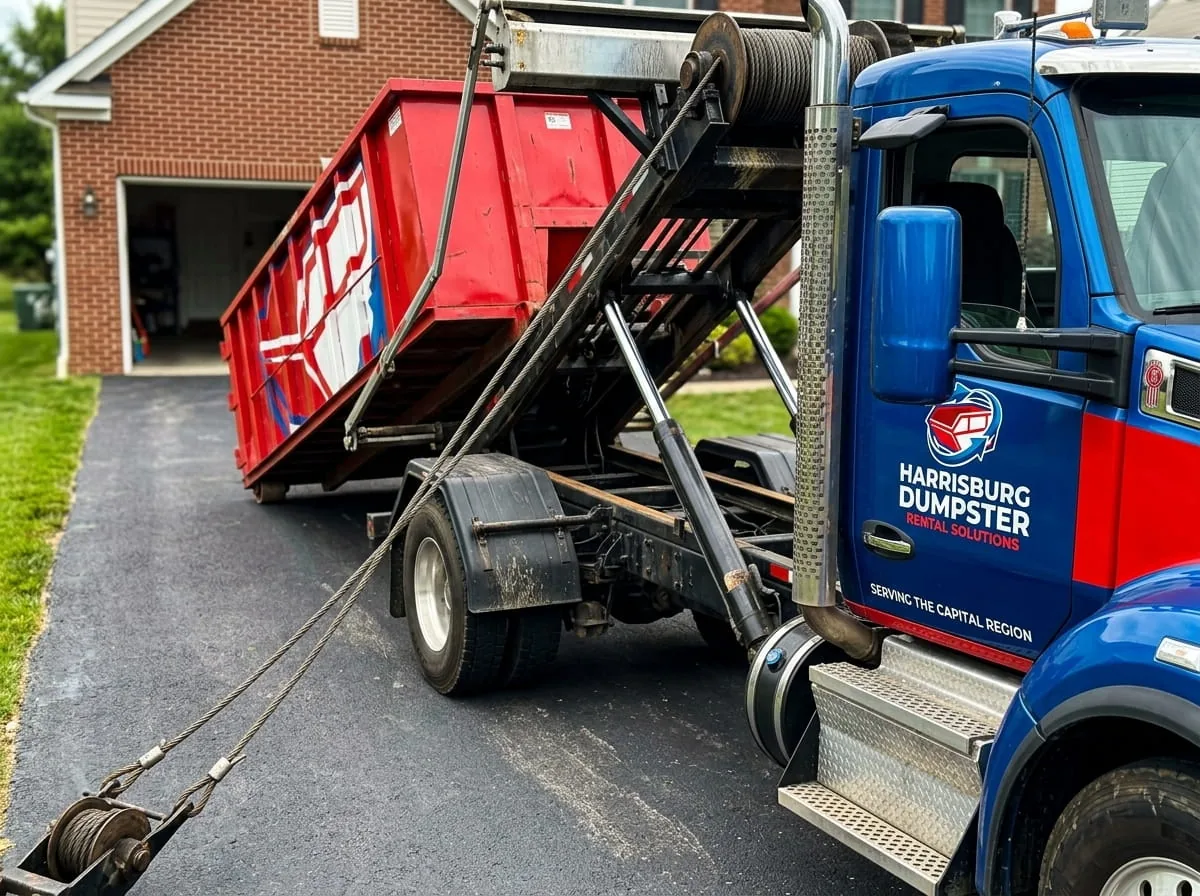
The short answer: on your driveway, no. On the street or sidewalk, yes — and the City of Harrisburg has a form for exactly this. Here is how it works.
The short version
If the container sits entirely on your own property — driveway, parking pad, yard, rear lot — you do not need a permit from the City of Harrisburg. You can book it today and have it delivered tomorrow.
If the container occupies a city street, a parking bay, a sidewalk or any part of the public right-of-way, you need a permit. The City's codes ordinance is explicit on this point: permits are required for occupancy of any street or right-of-way by a dumpster or other container.
The City publishes a Dumpster Permit Application alongside its other codes and permit forms. It is not an obscure or difficult process. But it does need to be done, and it needs to be done before the container arrives, not after a code enforcement officer knocks on your door.
Why this comes up so often in Harrisburg
Because a great many Harrisburg properties simply do not have anywhere else to put a container.
The rowhomes of Midtown, Allison Hill, Shipoke and Uptown were built with no driveways at all. Many have a narrow rear alley — often too narrow, or too obstructed, for a roll-off truck to service. For a renovation on a property like that, street placement is not a preference. It is the only option.
This is one of the defining features of doing renovation work in the older parts of the city, and it catches out-of-town contractors constantly. If you are working on a rowhome, plan for the permit at the same time you plan the demolition.
What the permit process involves
The specifics are set by the City and can change, so always confirm current requirements directly. In broad terms, expect to provide:
- The property address and the exact location where the container will sit
- The name and details of the hauling company placing the container
- The dates the container will be in place, from delivery to pickup
- The size of the container and the number of parking bays it will occupy
- Evidence of insurance from the hauler, in some cases
- The applicable fee
The City's codes documents and forms page is where the Dumpster Permit Application lives. If you are unsure which form applies to your situation, the Department of Public Works and the codes office can both point you at the right one.
How long you should allow
Do not leave this to the day before. Permit processing takes time, and the City is not obliged to accommodate your schedule because you left it late.
As a working rule for our customers: start the permit conversation as soon as you know your project dates, and certainly at least a week before you want the container on site. If your renovation start date is fixed and the permit is not through, you are the one paying for a crew standing around with nowhere to put the debris.
What happens if you skip it
A container sitting in the public right-of-way without a permit is a code violation. The consequences range from a notice and a fine through to being required to remove the container immediately — which, mid-renovation, is an expensive problem to solve at short notice.
There is a second, less obvious risk. An unpermitted container blocking a street or bay is a liability exposure. If a vehicle hits it, or someone trips over debris around it, you want to be on the right side of the paperwork. The permit is not just bureaucratic box-ticking; it is a record that the container was authorised, marked and placed properly.
Placement rules that make the permit worth having
Once you have permission to occupy the right-of-way, a few practical rules make the difference between a smooth job and a complaint from a neighbour.
- Mark it. A container on a dark street needs reflective marking. Most reputable haulers supply this; if yours does not, ask.
- Do not block sight lines. Never place a container at an intersection or where it obscures a stop sign or crossing.
- Leave the sidewalk clear. Blocking a pedestrian route creates an accessibility problem and, quite reasonably, complaints.
- Keep it tidy. Debris spilling around the base of a container in a public street is the fastest way to bring code enforcement to your door.
- Tell your neighbours. A container taking two parking bays for a week on a street where parking is already scarce is a genuine imposition. A conversation beforehand costs nothing and prevents a great deal of friction.
The surrounding boroughs and townships have their own rules
Harrisburg is the City, but our service area covers a dozen separate municipalities, each with its own approach to right-of-way occupancy. Steelton, Middletown, Hummelstown, Camp Hill, Lemoyne, Mechanicsburg and New Cumberland all set their own borough rules. Lower Paxton, Susquehanna and Derry Townships each have their own.
The principle is the same everywhere: on your own property, generally no permit; in the public right-of-way, ask first. But the forms, fees and processing times are not the same, and assuming your Camp Hill experience applies in Steelton is how projects get delayed.
When you call us, tell us the address. We deal with these municipalities constantly and we will tell you what you are likely to be dealing with before you commit to a delivery date.
The practical takeaway
Driveway placement: book it, no permit, done. Street placement: start the permit process a week out, get the form, get the approval, then book delivery.
Neither is complicated. Both are much less complicated than a code violation notice on a Tuesday morning when you have a demolition crew on site and nowhere to put the plaster.
If you are not sure which category you fall into, call us. We will tell you honestly — including in the cases where a driveway placement you had written off would actually work fine, which saves you the permit entirely.